The importance of taking extra supplies when traveling with NxStage

I have now been doing home dialysis with NxStage for over six years. During that time I have traveled over a dozen times, and did so again Thanksgiving weekend visiting my daughter in Chicago, IL.

When traveling for a week or more I have always taken an extra two days of premixed dialysate, saline, and warmer lines and miscellaneous supplies used for dialysis. I did this in case of a traffic accident, auto breakdown or even bad weather. Fortunately, I have never used any of these additional supplies.

When traveling this time I dialyzed in the morning of the Wednesday before Thanksgiving at home, then left for Chicago (I live in Lansing, MI so it’s about a four hour drive). I planned to dialyze at the Hotel on Thursday morning, and again Friday morning, then we would return on Saturday and I would dialyze at home that evening like usual.

While loading supplies for the trip into our SUV, my wife asked why I was taking one additional box of premixed dialysate, as we would only need to dialyze at the hotel two times. I responded just in case. She reminded me that in all our travels with NxStage we have never needed any of the extra supplies we took. But I continued with the extra supplies.

While setting up on Thanksgiving morning at the hotel I opened the first box of premixed dialysate and hung the two 5-liter bags like normal. I opened the second box and when I tore open the outer bag on the next bag of dialysate, it leaked about half the bag on the hotel room bed, apparently the inner bag had been comprised. Good thing I had packed an extra box of dialysate.

I continued with setup and when connecting the warmer lines I found that I could not unscrew the cap that connects the line from the bag on the warmer to the cartridge. I have pretty severe arthritis, so I asked my wife for help. She was also unable to unscrew the cap, even using pliers. It looked like one end of the cap was glued on, with a milky colored substance on the threads. I have never encountered this before, but was unable to use that short connecting line.

Luckily, I had also packed one extra set of warmer lines, so I simply took the connecting line from the spare warmer lines to replace the defective line and ran like normal.

Don’t get complacent about not packing extra supplies, after dozens of successful trips without ever needing any of the extra supplies, I used two times from the extra supplies I took on this trip.

Have fun with vacations and travel. Hemodialysis is tough enough by itself, but traveling with NxStage has made my life dramatically better.
Standard

How would you like to speed-up cycler setup, and virtually eliminate Snap and Tap?

If you are like me, you will do almost anything to save time when dialyzing.  
Recently I received an email from NxStage indicating they have developed new system setting for the NxStage cycler that can almost eliminate Snapping and Tapping. The new system settings are:

Table 1: Alternate System Settings
System Setting       Description                              Value 

           22                    Dialyzer Flush FP                  40

           23                    Dialyzer Flush UFP                20

           24                    Dialyzer Flush BP                   250

           27                    Prime FP                                   40 

           32                    Recirculation BP                    600

I was very excited to try these new settings and made these changes to my NxStage the day after I received the email. However, each day I still had some air in the system, and and had to continue to Snap and Tap to remove the air. After a few days of this, I decided to just change the system settings back.

About a month later while speaking with my Dialysis Nurse, she asked if I knew about the new system settings, and that it would reduce or eliminate Snap and Tap. I told her my experience, and why I was no longer using the new settings.  

She told me that she was training new patients on the use of NxStage, and all the new machines use these settings, and it has eliminated Snap and Tap. She said that air still forms in the cartridge, and that must still be removed. 

I changed my machine to use the new settings again, and added a step to clear the air from the cartridge. It working very well, and I have now eliminated the Snap and Tap.

One word of warning, using the old settings the NxStage took 15 minutes to prime. Using the new settings it now takes and additional 8 minutes, for a total of 23 minutes to prime. In my opinion, a very minor inconvenience for the ability to eliminate Snap and Tap.

If you are interested in making these system setting changes and saving the time you used to spend doing Snap and Tap, please follow the User Guide instructions to update your cycler settings. Please note that when using a System One S, the System Setting 0, CAR_TYPE, must be set to 0.

Please review the entire document provided to me by NxStage, here’s the link.

Click to access COMM0512_Snap_and_Tap_Letter_to_Customers___Patient_Letter.pdf

Standard

Ongoing fistula problems – now I need a new button-hole

Over the last week or two I have had problems when inserting needles in my button-hole fistula. I have been told by my Nephrologist that button-hole fistula last about four years and mine is almost five and a half years old.
On the Friday before the 4th of July weekend, I again had problems with just the Venus potion of my fistula, and was unable to dialyze over the next four days because of the the 4th of July holiday.

On Tuesday July 5th I had an angioplasty and both a clot removed from the Venus portion of my fistula, and had narrowing removed around it to improve my blood flow.

Unfortunately, one of the two incisions made for this treatment was very close to the arterial portion of my fistula, and caused problems with the arterial portion of my access.

Just over one week later I was again unable to dialyze because of a clot in the arterial portion of my fistula. I had another angioplasty on the following Wednesday, but they were unable to remove the clot and the arterial part of the fistula no longer worked.
Now on my third day after no dialysis, I am running in-center for the first time in coming up on six years, using a dull needle in the Venus portion of my fistula, and a sharp needle in the arterial portion.

The plan will be to create a new arterial button hole over a period of time, and go back to using dull needles in both sides of my fistula.

I have been told multiple times by my Nephrologist that the maximum time a dialysis patient can go without dialysis is 96 hours, and I went that length of time just over a week ago, and went 72 hour again just over one week later.

What can you do if you have fistula problems, and cannot dialyze?
I am very careful with my food and especially liquid intake, severely restricting both. To avoid issues with high potassium I also used Kayexcellate on a daily basis to reduce my potassium. I also took extra Renvella, a phosphorus binder to control my phosphorus level.

I guess I have proven you can survive this, but you have to be very careful with diet, fluid intake and levels of potassium and phosphorus. I was also very careful with sodium intake, as it can also become life threatening without dialysis.

On the fourth day I felt very tired, but not as bad as I thought it would feel to be approaching the danger point. I asked the Nephrologist how I would know when I was in serious trouble. She responded that I would become more and more tired, I would become nauseated and may begin vomiting, and that if my pulse dropped to 50 or below I needed to go to the hospital immediately.

I began wearing my Fitbit to constantly monitor my pulse and by the time I had reached the 95 hour mark my pulse had dropped to 58. Luckily we returned home from the angioplasty and I immediately dialyzed.

I’m sure you have heard this before, but take extra care with your fistula – it really is your life-line. Without a functioning fistula, you have about 96 hours before it may become life threatening.

Standard

Heart attack follow up – Cardio Rehab

I have now finished the three-month Phase 2 of Cardio Rehab and have now begun Phase 3. This sounds more impressive than it actually is, Phase 3 simply means I no longer wear a heart monitor when I work out, I can work out on any schedule I choose during the week, and the big difference, I pay for the use of the Cardio Rehab facility instead on my insurance.

At the conclusion of Phase 2 I did another test to determine my improvement level. I increased my metabolic rate by 46%, and increased the distance I went on a Schwinn Air Bike over a six minute period by 30%. The huge difference is in how much better I feel, and the higher energy levels I have, and of course the benefits regular exercise does for my heart.

I attend Cardio Rehab three times per week, for just over an hour and half per visit on Monday, Wednesday and Friday. I begin with a begin with a blood pressure and pulse rate measurement. I start my workout with 2 minutes warm-up on a treadmill, followed by 14 more minutes at 2.7 miles per hour, and incline level 2. This doesn’t work my heart too hard, but gets me warmed up for my additional exercises.

Next I use a rowing machine for seven minutes. This really gets my heart pumping. I follow this with six minutes on an exercise bike, or a SciFit arm machine. Either of these also get my pulse rate up to the recommend exercise rate.

Then, I use a Nustep machine. I set the resistance level to level four, and try to keep my watts at 100+ for 15 minutes, followed by a two minute cool-down where I keep my watts at 60-70.

Next I do a set of four standing stretches, then a series of ten repetitions of four exercises with nine-pound free weights, and finally a series of sitting stretches. I complete the workout with an ending blood pressure and heart rate.

My overall blood pressure numbers have been reduced by my exercising and I am no longer taking any blood pressure medications. And, I feel great compared to how I felt prior to my bypass surgery.

I’m sure you have heard this before from your healthcare providers, but hemodialysis is a stress on your heart.  And if you are not getting any regular exercise, you need to start some type of exercise program to help your heart keep up with the increased stress on it from hemodialysis.  It was difficult to start my exercise program, but now I feel great and plan to continue with it indefinitely. 

Standard

Do you use liquid soap as part of home hemodialysis?  And, do you replace the soap container every time you empty one, or refill it?

As part of home hemodialysis I have an annual home visit by the dialysis center to ensure I am following established procedures, and and recommendations for cleanliness and infection control.  
During my last visit I mentioned that it was almost time for me to refill my small liquid soap container from the bulk bottle I purchased. The dialysis nurse said that they now recommend that the small liquid soap bottles be replaced each time they are emptied, and not refilled, to reduce germs and contamination of the plastic container.

I thought about this and decided that I will continue to refill my soap container, not replace it each time it’s empty. Here’s my logic; during my decades of employment I worked as a technology consultant to manufacturing and distribution customers. I worked in many companies assisting with their implementation of technology for both manufacturing and distribution. I recall manufacturers making products similar to liquid soap.

When the products are completed a person loads 12 to 24 of the products into shipping container for shipment to a distribution center. The employees that do this task are sometimes paid both an hourly wage, and a piece wage to encourage quickly loading their products into boxes. The more they load, the greater their wage. They are very good at this, and do it very quickly. They also get very little time for restroom breaks or for lunch. I never asked any of them, but I fear many do not take the time to wash their hands after a restroom breaks. I also witnessed employees who were sick, who still came to work to earn their badly needed wages. If they are sick while working, their germs and bacteria end up on the products they are packing for shipment.

Eventually those products arrive at the retailer in boxes. The retailers pay contractors or employees to unload the boxes and place those products on the shelf. They have the same issues as the people loading the products into shipping boxes. Did they wash their hands after using the restroom, or do they also work when they are sick, inadvertently getting germs and bacteria on the products they are unloading and placing on the shelves of your favorite store?

If these new soap containers don’t yet have enough germs on them, what about the parent of a sick child who is at the store browsing for liquid soap after touching their sick child, picking up the soap container to read the labels or prices prior to making a final purchase decision?

I contend that the new soap containers from any retail store are potentially more contaminated than the one I have been using, refilling and had control over in my own home.

Every time I refill my soap container, I also thoroughly wipe all exposed surfaces with a Chlorox wipe. I have been doing home hemodialysis and refilling my soap container for over five and a half years, and have never had an infection with my fistula. That’s a good thing because a sepsis infection in an AVF fistula can be lethal.

I also get a lower price on bulk soap refills, and feel better about reducing the amount of plastic waste I put in my trash, that ends up in the local landfill. If you disagree with my thoughts here, please leave a comment and let me know why, maybe I’ll change my approach. But for now, I will continue to refill my liquid soap container, and not purchase a new one each time I empty one.

Standard

New Fistula Problems – Narrowing and Scar Tissue

Over the last ten days I have had high Venus pressures and pain in the Venus portion of my fistula while dialyzing, and pain in my fistula after completing dialysis. Some days the pain would subside and my Venus pressures were lower, although still elevated. When I ran last Friday I had a higher level of pain than I had before, and pain in my fistula after I finished running.

I called the vascular care office and they were able to get me in this morning (Monday). After using a scope on my fistula the doctor told me there was some narrowing in my fistula, and that scar tissue was also contributing to my problems. He said the scar tissue was causing the pain I was having during dialysis.

I questioned how I was getting scar tissue in my fistula. He replied that when you run at pump speed 500, the blood sprays out of the two openings in the fistula a needle, and this hard spray inside your fistula can cause scar tissue. I have been running on this fistula for over five years and this is the first time I have had an issue with scar tissue.

I asked the doctor how the scar tissue can be dealt with, then I got the bad news, nothing can be done to repair damaged scar tissue. He advised dialyzing at a lower pump speed to lower the chances of causing more scar tissue and to protect my fistula from further damage.

The doctor performed an angioplasty, he made a small incision just below and to the right of my arterial button-hole, and used a balloon-shaped catheter to enlarge the Venus portion of my fistula. Since the surgery, my Venus pressure has been reduced while dialyzing this evening, and my pain during dialysis is gone.

My dialysis center has always advised using the highest pump speed possible, for me that was 500. The arterial doctor advised me to use a lower pump speed as long as I was getting adequate clearance. He advised using a pump speed of 350-400. I’m not sure that I can put up with the increased run time using this slow of run speed. When I started tonight, I set the pump speed at 400, and my total run time to remove 1.6L would have been 2 hours and 50 minutes. My normal run time were less than 2 hours and 15 minutes.

I plan to start reducing my run speed, but am cautious to reduce it from 500 to 400 without ensuring that I will continue to get adequate clearance at the lower pump speed. My plan is to use the lower pump speed of 400 the day I draw blood for my monthly labs, so I can find out what the reduced pump speed does to my clearance, before making the final decision on what run speed I will be using.

My next blood draw will be in another in two and a half weeks, in the mean time I plan to use a maximum pump speed of 450. I’ll post a follow-up blog entry to advise how this works for me, and how the lower pump speed affected my clearance value.

02/18/16 Update – I have been running with a pump speed of 450, and it has added about ten more minutes to my run time and my clearenace stayed the same.  My concern with reduced clearenace at the lower pump speed was unfounded.  The NxStage System One is automatically calculating your run time based on Dialysate Rate.  Dialysate Rate is based on a combination of UF Goal (amount of liquid to be removed) and pump speed.  When I run at a lower pump speed, the total time to remove the liquid actually stays the same, but the length of time to use all the Dialysate lenghthens by about 10 minutes.  The great new is that on a NxStage you can lower the pump speed and never affect your clearenace, the NxStage System One is always providing the same amount of cleareance by lengthening the run time.  The reason cleareance would be an issue based on lower run speed is only when you are dialyzing in-center, you are limited to a specific amount of time so they can the next dialysuis patient on and started.

Standard

First time I’ve had this error – Warning Error 71

I have been doing home hemodialysis for five and a half years and for the first time got this warning error when I first powered on the NxStage System One in preparation for setting up. 

The troubleshooting section of the NxStage manuals indicates – SCHEDULE PREVENTATIVE MAINTENANCE: PREVENTATIVE MAINTENANCE DUE (YELLOW CAUTION).     

I called NxStage Technical support and they indicated I needed to have my NxStage sent back to the factory for preventative maintenance. The good news – I could simply press the MUTE button to reset the warning error and continue with setup. This error will reoccur each time the NxStage System One is powered on until it is replaced.

NxStage sent me a new System One in about one week. Like usual, great service from NxStage. Even though I received the same warning error each time I powered the old one on, I simply pressed the MUTE button to continue setup.

The only caution I have about replacing your System One is the requirement to set the System Settings. See the NxStage User’s Guide to document all of the current System Settings on your current System One BEFORE replacing it with the new unit.

Appendix A in the User’s Guide indicates how to access the NxStage System One user settings, and documents each of those settings. While reviewing the settings on my current System One, I simply used a pencil to document the value of each setting in the User’s Manual. It made changing each of the settings on the new machine very easy.

Many of the settings did not need to be changed, but by documenting each setting from the old machine, and verifying each one on the new machine, I was confident my new machine would do exactly what the old one did during my hemodialysis treatments. 

I know it’s been a few years since I last replaced my System One due to a pump failure, but this particular error has been a very rare experience for me.

Standard

Hemodialysis patients are more prone to heart attacks – a cautionary story from someone who has been there

I have always followed the advice of my physicians, maintained a healthy weight, exercised, and maintained a very low A1C for the 54 years I have been a type 1 diabetic. I see a cardiologist twice a year, once for a stress test, and a second time for an EKG. After my last EKG in December of last year, the cardiologist told me my heart was doing great. Despite all these precautions, hemodialysis still takes a high toll on your heart.

After feeling extremely tired for about one week, I started running a low grade temperature after dialysis, felt even more tired than normal, felt nauseous, and started vomiting. After five days of these symptoms I went to Sparrow Emergency early Sunday morning, July 26.

Blood work showed I had suffered a heart attack. Physicians tried but were unable to place a stent, and I was told I need bypass surgery.

I was shocked at being told I had had a heart attack, I assumed I simply had some type of infection that was causing my symptoms. The heart surgeon told me that he would normally recommend drug therapy for someone my age (I’m 59), but because of my health conditions, open heart surgery was my only viable option.

After not being able to sleep or eat for five days while in the hospital, I was sent home for one week to recuperate before surgery.

I returned at 6:00 AM on Monday, August 10 for a four-way bypass. The heart surgeon did a superb job, I was released after eight days in ICU at about 10:00 PM August 18.

My heartfelt thanks to the team of physicians and ICU nurses who took care of me during my stay in ICU, I am home now home, getting stronger every day.

Because of my diabetes and kidney failure, I knew someday I would have heart issues, but I was shocked it happened so early in my life. The heart surgeon said that because of genetics, a sharp “turn” in the main artery on the front of my heart, and my other health issues, this was the result.

Had I not felt so badly Sunday morning when we went to the emergency room, I would have ignored these systems, not gone to the emergency room, and possibly died. I never had chest pain, or any other classic heart attack symptoms.

The heart surgeon told me that diabetics and hemodialysis patients many times have no chest pain when they suffer a heart attack.

I advise everyone on hemodialysis, and/or diabetics to regularly see a cardiologist, take every precaution recommended by your physician team, and do not ignore any symptoms like I suffered for almost a week before seeking medical attention. It could very well mean the difference between life and death.

I am amazed how quickly I have recovered from open heart surgery, and also feel very lucky that I has such a skilled surgical team. I have been home for just over three weeks, my condition improves every day, and I look forward to enjoying the rest of my life after this life changing surgery.

Standard

One More Thing To Verify When Opening The Cartridge

Last week after starting setup and after completing the system prime, I discovered the white clamp on the saline “T” missing. I didn’t want to throw away the cartridge and start the prime over, so I simply replaced the missing clamp with a hemostat. After I connected the saline line to the “T” I removed the hemostat because if a encountered low blood pressure while dialyzing, I would simply unclamp the remaining white clamp instead of the normal two white clamps. 

If the missing clamp had occurred almost anywhere else on the cartridge, I may have had to start over. Here’s one more simple step that must be checked before using any cartridge, ensure all the necessary clamps are in place BEFORE using the cartridge.

Standard

Another succesful vacation with NxStage System One

We just returned home after another successfull vacation with NxStage System One.  A week long vacation at a friend’s farm in New Jersey over Memorial Day and another few days.  Warm sunny weather and a week among friends.

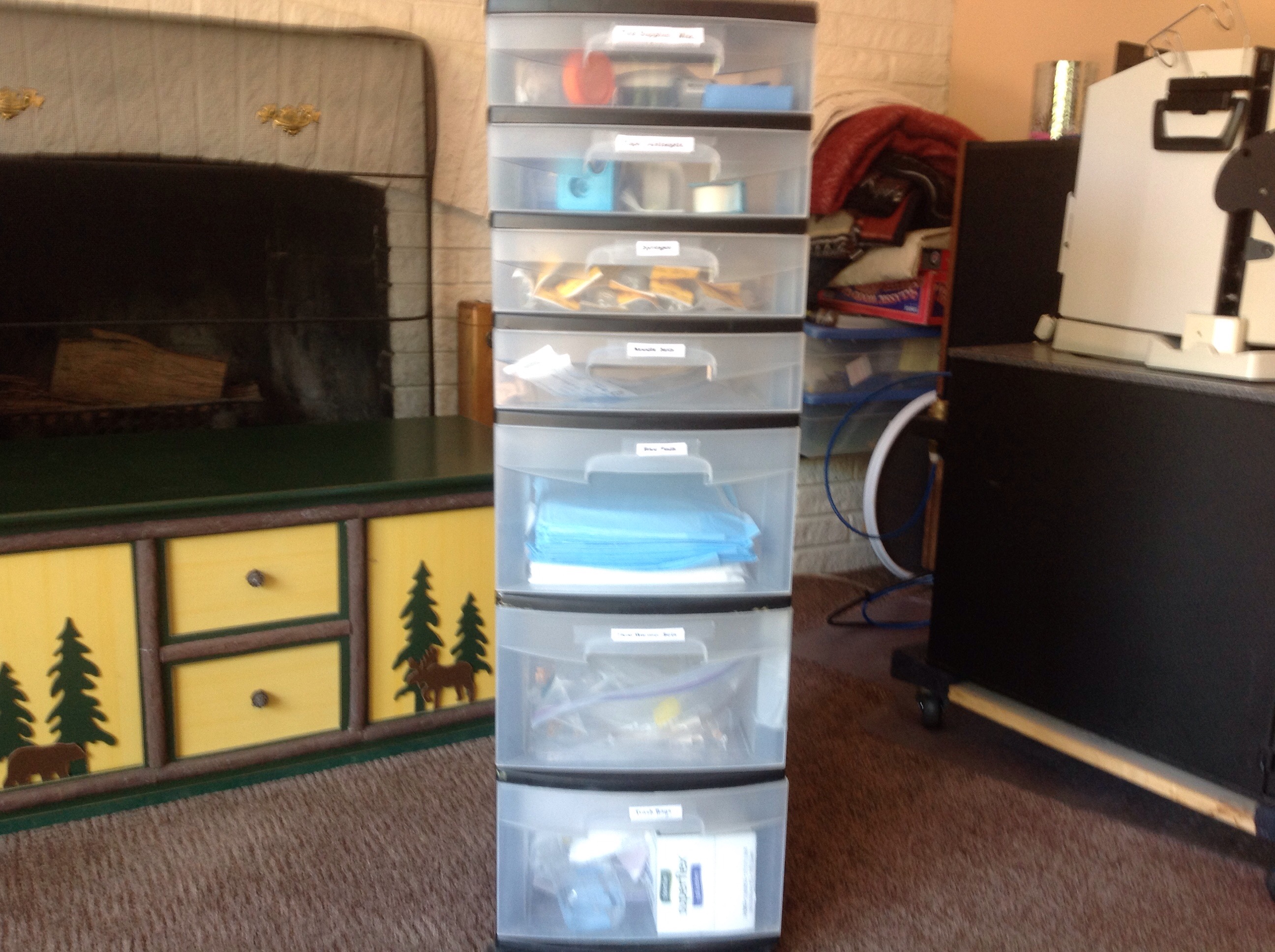
I took bags of premixed dialysate, saline and my cart of all my supplies. 

 
I use this cart when I dailize six times per week at home, and I put it in the back of our SUV when I travel. The  picture is too small to read the tags on the drawers, but they are from top to bottom – Test Supplies/Misc, Tape Antiseptic, Syringes, Needle Sets, Blue Pads, Fluid Warmer Sets, and Trash Bags.

I also pack the bag warmer, cartridges, Clorox wipes, liquid soap, Purell, paper towels, and the manuals.  All of it including a weeks worth of dIalysate, other miscellaneous supplies fits in the back of our Toyota Highlander.

If you’re like me, the ability to travel on a planned trip or a last minute trip is one of the reasons we decided to do Home Dialysys. We take one or two trips a years and travel within the state of Michigan and across the country.

Standard